Mike Coleman’s murder
Panic RoomMike Coleman’s murder is revealed through clues in the kitchen at Wortalleth West: marks that recall another death, freezer containers moved out of place, and finally Coleman’s body inside the appliance. The discovery turns an investigation of suspicious traces into confirmation that a colleague has been killed, while leaving the identity and precise circumstances of the killer unproven.
Clues in the Kitchen
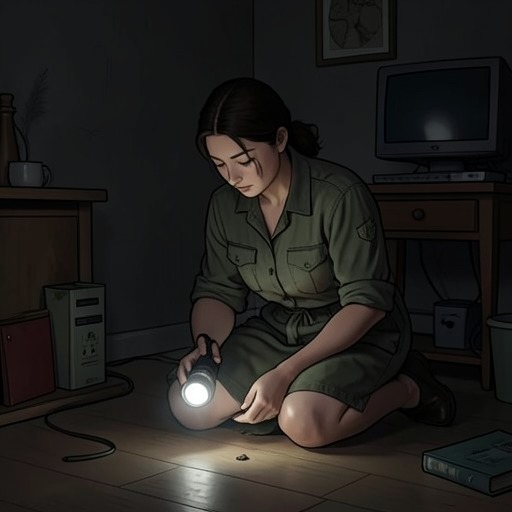
After looking around the study, Jack Harkness went into the kitchen with Don following. At first, its clean surfaces appeared ordinary. When Harkness switched on the light, however, it exposed dark, deep scuff marks across the tiles near the telephone. Don could not identify their cause. Harkness connected them to marks from a kitchen in a Moscow apartment owned by a recently deceased business associate. In that earlier case, the associate had been strangled with his own tie, and the marks had been made by his shoes as he struggled. Harkness said Zlenko had visited the Moscow apartment and concluded that he had probably been at Wortalleth West as well.
The Freezer and the Confirmation
The displaced freezer containers sharpened the kitchen clues into a search for what was missing. Harkness pointed out reinforced plastic trays stacked in a corner and frozen food left to thaw beside the sink. When he opened the freezer, its contents held the door against him; he managed to pull it open only a few inches. Inside, Don saw a blond-haired man in a pale suit, dusted with ice. Harkness identified him as Mike Coleman. Coleman’s body obstructed the door, so Don carefully moved his head clear, bringing the discovery fully into view.
The death changes the meaning of the investigation for Don. He had been following Harkness through a kitchen that initially seemed orderly; now the moved containers and thawing food register as traces of a concealed killing. Don’s response is physical as well as verbal: he realizes that he is shaking, feels weak, and notices his heart fluttering before he names what has happened as murder. Harkness’s comparatively controlled response underscores the shock without making the discovery less conclusive: he acknowledges that Coleman has been murdered, but the scene does not establish exactly how or by whom.
Asked why Coleman might have been killed, Harkness offers a tentative explanation rather than proof. He describes Coleman as irritating and inclined to manipulate situations for his own advantage, then guesses that Coleman had entered circumstances beyond his understanding. Harkness adds that Zlenko could react violently when provoked. Set beside the scuff marks and Harkness’s account of the Moscow death, this suspicion makes Zlenko a significant link between the two kitchens, but it remains Harkness’s inference; the evidence in this discovery does not confirm the killer’s identity or the precise sequence of events.
Evidence and Inference
The discovery is consequential not because it solves the murder, but because it clarifies the limits of what the kitchen can prove. The comparison with the Moscow death gives Harkness a basis for suspecting a connection, while the traces at Wortalleth West remain clues rather than a complete account of events. His explanation of Coleman’s possible motive is likewise presented as a guess, not a verified finding. The scene therefore advances the investigation while preserving its central uncertainty: Coleman’s murder is established, but responsibility and the exact circumstances remain unresolved.
Recognition and Uncertainty
The scene moves from observation to recognition in stages: the lit tiles prompt an explanation, the freezer’s obstruction delays a clear view, and Coleman’s identification makes the suspected violence undeniable. Don’s realization arrives through his own response before he can fully steady himself; Harkness, by contrast, interprets the clues through an earlier case and advances a theory about Zlenko. That difference gives the discovery two levels of knowledge: the murder is confirmed, but its reconstruction remains provisional. The kitchen yields enough evidence to alter the investigation, not enough to settle responsibility.